Shelter’s euthanasia protocols questioned after dog bites staff and prisoner
Surveillance video and shelter records raise questions about whether Clayton County Animal Control followed state protocols before euthanizing a dog named Barney.
JONESBORO, Ga. (Atlanta News First) — Shelter staff described a 2-year-old pit bull named Barney as “people-friendly and very sweet” when he arrived as a stray to the Clayton County Animal Control facility in late January 2026.
The shelter had not documented any aggression toward other dogs or staff, until weeks later when a rescue was coming to pick him up.
Clayton County Police Department, who runs animal control, said Barney “attacked” a kennel staff and state prisoner on work duty at the shelter when they attempted to insert a microchip in him. The next day, Barney was euthanized. His head was then removed and sent for rabies testing. Advocates said Barney wasn’t to blame for the incident.
Atlanta News First Investigates obtained shelter records, email correspondence, and surveillance video that raise questions about whether the county followed state protocols, and whether it accurately reported the timeline of Barney’s death to state inspectors.
Barney and the bites
The animal control officer who picked Barney up off the streets on Jan. 21, 2026, wrote a police incident report stating his offense was “running at large.”
Barney was not neutered and therefore placed on the urgent list as rescue only.
Three weeks later, on February 12, the animal rescue organization Poor Paws said it was coming to get him. Staff and two state prisoners then inserted a microchip near his neck in preparation for his release.
The Clayton County Police Department captain in charge of animal control, Kevin Hughes, said they bring inmates to work at the shelter because they are understaffed.
Surveillance video, obtained through an open records request by Mimi Steger of the Shelter Reform Network, showed an inmate wrapping a rope leash — known as a “soft lead” — around Barney’s snout as a makeshift muzzle. After the microchip was inserted, the prisoner removed the lead. That’s when Barney lunged.
The police incident report states Barney bit the prisoner’s thumb and a staff member’s arm. Both required reconstructive surgery.
The other prisoner got a leash around Barney, when he was on top of the kennel staff, and Barney calmed down.
What the county did next
Barney was euthanized inside an animal control truck kennel the next morning on February 13.
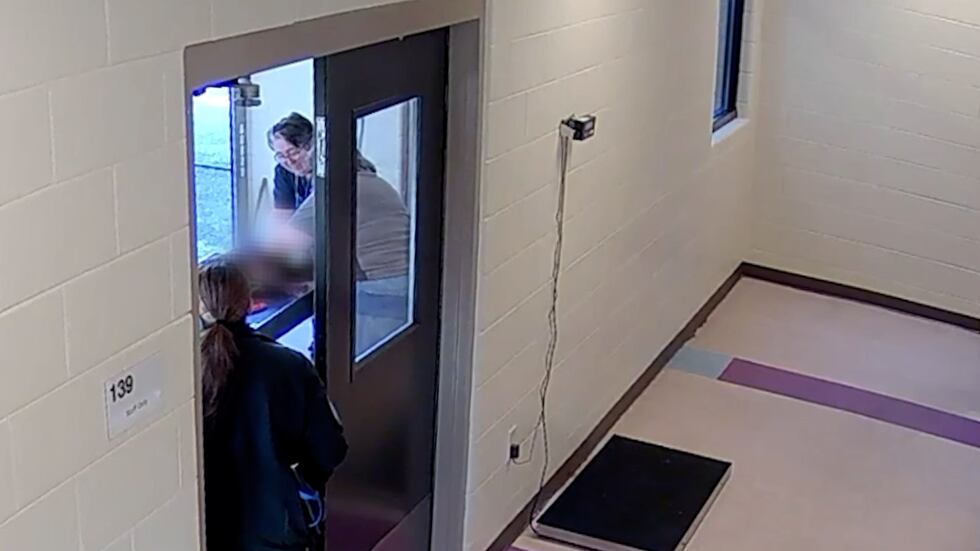
The video that advocates obtained from a hallway surveillance camera showed the veterinarian and a vet tech through windows on the entry door cutting off Barney’s head from his lifeless body, a procedure conducted for rabies testing on larger animals such as livestock. Barne’s body was on a trolley cart in an open bay. The veterinarian was wearing a shirt and jeans with plastic gloves as she cut. The vet tech was also only wearing gloves.
The police incident report of the bite from Feb. 12, 2026, said the dog “had not previously shown any aggressive tendencies toward staff” and “was humanely euthanized and submitted to the State Epidemiology Lab in Decatur for rabies testing in accordance with standard bite protocol.”
After the video reached the public, Clayton County Animal Control said in a Facebook post that the Georgia Department of Public Health (DPH) requires a specific brain specimen for analysis and does not accept an animal’s entire body for testing, and that testing was critical so injured individuals and their doctors could make “timely and informed medical decisions.”
Steger said the procedure captured on surveillance video was not what advocates expected to find.
“Barney had been placed on a plastic trolley cart just outside the doors into the hallway of the shelter, and the veterinarian and a veterinary technician proceeded with the rabies sampling, removing Barney’s head while not wearing PPE,” Steger said. “They didn’t wear any facial coverings; only gloves were used. It was stunning, to say the least.”
Email records from Feb. 13, 2026, show the rescue organization Poor Paws wrote the shelter, “Once his quarantine is up we will still pull him. I will sign whatever necessary.”
The Clayton County Animal Control rescue coordinator responded within four minutes: “He is no longer available, but I appreciate your compassion!”
What the records show
Clayton County police records show discrepancies. Barney’s kennel card said he was euthanized on Feb. 13, but also listed him as “bite quarantined” from Feb. 12-22. A 10-day quarantine after a bite is standard protocol, according to DPH rabies guidance.
Internal drug logs also show Barney was euthanized through intracardiac injection, also known as the heart stick, a controversial, painful method Georgia law stipulates should only be used as a last resort on an unconscious animal.
The Georgia Department of Agriculture (GDA), which oversees state shelters, inspected the county shelter a month after Barney’s death, in response to several citizen complaints regarding Barney and other dogs.
The state issued the county a violation for euthanasia. Atlanta News First Investigates found the Clayton County Animal Control staff veterinarian used it nearly 90% of the time from January 2025 to February 2026.
The inspection report also stated Capt. Kevin Hughes, who oversees animal control for Clayton County Police, told the GDA inspector Barney was euthanized “approximately 10 days” after the incident. Records show it was the next day.
GDA told Atlanta News First Investigates they removed the violation on the same day they issued it because police told inspectors they had switched to using a third party for euthanasia.
However, in July, Clayton County Police told us the staff veterinarian performs all euthanasia.
GDA said they conducted a follow-up inspection in June and found no violations.
When Atlanta News First Investigates requested training protocols for inmates working at the shelter, Clayton County Police said there are no written protocols, but “only a checklist.”
Hughes addressed inmate training at the June animal control board meeting. “We are deficient in employees,” Hughes said. “We were not keeping records of how we were training, but they were being trained. Now those records are being kept.”
Quarantine and testing
Dr. Amanda Feldpausch, a deputy state epidemiologist with the DPH, said the state recommends a 10-day observation period when a dog has bitten someone.
Feldpausch explained that an animal with rabies will show signs and will die within days, making observation a reliable method over euthanasia and testing.
Feldpausch said keeping the animal alive — if it is humane, healthy, and a safe and secure location is available — is preferred, because if the animal survives 10 days, it did not have rabies at the time of the bite.
If anything happens with the brain specimen during shipping, she said there would be no way to know if the animal was infected. “Since we did not observe that animal for 10 days, we can’t be confident it didn’t have rabies,” Feldpausch said.
Steger and other advocates do not support the county’s decision to euthanize Barney before the quarantine ended.
“He had already been impounded over 20 days and had shown no signs of rabies and could have been quarantined,” Steger said. “So if they believed Barney posed a real rabies risk and needed to be sampled, then why were the veterinarian and the vet tech assistant not fully outfitted with full PPE?”
Barney’s rabies test results came back five days later as negative.
Transparency concerns
Less than a month after the surveillance video surfaced publicly, Clayton County changed several of its cameras to live feed only, meaning the public can no longer request recorded footage.
“The change to certain internal surveillance camera settings in March appears to have been an operational or administrative decision,” Clayton County Police Captain Michael Martin said. “There is no universal requirement that every internal surveillance camera continuously record, and camera settings may vary depending upon their intended purpose and location.”
The county is also no longer providing drug logs through open records requests which is how advocates now how animals are being euthanized, including a Clayton County Sheriff’s K9 named Kona.
There is at least one pending lawsuit challenging the denial of records.
Policies
The GDA’s inspection report states the department does not have jurisdiction over internal business operations, including the use of inmates at the shelter, and that internal issues must be addressed by Clayton County government officials.
The state inspector also wrote animal outcome decisions are “solely the responsibility of the shelter” and GDA has “no authority in these decision-making processes.”
The county has not been found responsible for any wrongdoing in Barney’s case.
Atlanta News First Investigates asked Clayton County Police for its protocols on microchipping. Hughes said it’s not considered a medical procedure and doesn’t require medical training.
Poor Paws confirmed it had planned to take Barney but declined further comment. Advocates are asking for written protocols, transparency, accurate reporting, proper training, and an external audit.

If there’s something you would like Atlanta News First Investigates to dig into, fill out this submission form.
Download our Atlanta News First app for your latest news and information.
Atlanta News First podcasts are available now on: Spotify | Apple Podcasts | Amazon Music | YouTube
Copyright 2026 WANF. All rights reserved.